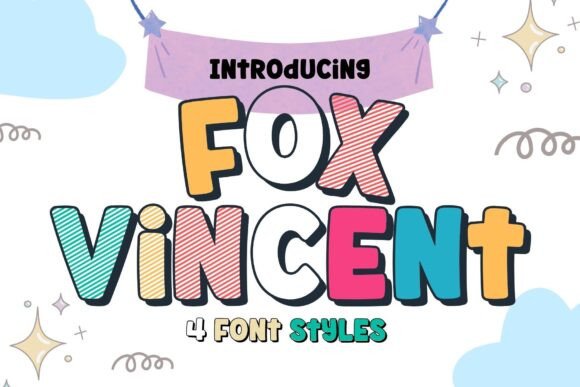
Fox Vincent Display Font for Handmade Creators
If you’ve ever spent ten minutes tweaking a label just to get the right “spark” — that subtle lift of charm, playfulness, and polish — then Fox Vincent is the display font you’ve been waiting for. As someone who designs printable wall art, hand-stamped tags, wedding stationery, and SVG files for Cricut users, I’ve tested dozens of display fonts. Few balance personality and practicality like Fox Vincent does — especially when your work lands on physical products.
Fox Vincent isn’t a script or a serif — it’s a confident, friendly display typeface with four distinct styles: Regular, Bold, Italic, and Bold Italic. Each one carries that same effortless coolness: rounded terminals, gentle contrast, and just enough quirk in the letterforms to feel handmade without sacrificing clarity. It doesn’t shout — it invites. That’s why it works so well on products where first impression matters: candle jars, boutique gift tags, enamel pin mockups, or chalkboard-style welcome signs at farmers’ markets.
For crafters using cutting machines, readability at small sizes is non-negotiable. Fox Vincent holds up beautifully at 12–16pt on product labels (think soap bars, jam jars, or herbal tea tins), especially in the Bold style. The open counters and generous x-height mean Silhouette Studio and Cricut Design Space render clean cuts every time — no fragile serifs or tangled swashes to snag your blade. And because it’s designed as a display font, it shines brightest where impact matters most: headlines, titles, and short phrases. Avoid using it for full paragraphs or ingredient lists — but for “Hand-Poured Soy Wax,” “Est. 2021,” or “You’re Invited!”? Absolutely perfect.
I’ve used Fox Vincent across seasonal product lines with great results. Last fall, I paired the Bold Italic with a warm, neutral sans serif for a set of printable pumpkin patch signage — the contrast gave rustic charm while keeping everything legible from six feet away. For holiday mugs and tote bags, the Regular style adds just enough personality without overwhelming the design. And for wedding welcome boards? The Italic version brings soft elegance — especially when layered over linen-textured backgrounds or watercolor washes.
What makes Fox Vincent especially useful for digital product creators is its versatility across formats. Whether you’re building Canva templates, designing SVG bundles for Etsy, or creating layered PDF printables for planners, the four included styles give you built-in hierarchy options. Use Bold for section headers, Regular for subheads, and Italic for decorative accents — all within one cohesive family. No awkward mismatching or licensing headaches between weights.
Font pairing is where Fox Vincent truly sings. Try it with a relaxed handwritten font for greeting cards (think birthday or baby announcements), where Fox Vincent anchors the name or date with structure while the script adds warmth. Or pair it with a crisp, low-contrast sans serif — like Montserrat or Inter — for packaging labels that feel both artisanal and trustworthy. For farmhouse-style wall art, combine Fox Vincent Bold with a simple serif like Playfair Display for timeless contrast. These combinations reinforce brand consistency across your shop: customers begin to recognize your aesthetic not just by color or layout, but by how your typography feels — friendly, intentional, and quietly confident.
Practically speaking, Fox Vincent includes standard OpenType features — basic ligatures and stylistic alternates — which add subtle refinement to words like “the,” “and,” or “with.” You won’t find extravagant swashes or discretionary ligatures here, and that’s a strength: this font was built for makers who need reliability, not ornamentation for ornamentation’s sake. It supports Latin-based languages (including extended accented characters), making it safe for bilingual greeting cards or international Etsy listings. Files come in .OTF and .TTF — fully compatible with Adobe Creative Suite, Affinity apps, Cricut Design Space, Silhouette Studio, and free tools like Canva and Google Fonts (when self-hosted).
Licensing is a quiet but critical detail. Fox Vincent is a commercial font — meaning you’re fully cleared to use it in physical products you sell (like printed invitations or embroidered patches), digital downloads (printable planners, SVG cut files), client work (logo design, social media graphics), and even merchandise (t-shirts, mugs, stickers). Just remember: you may not resell or redistribute the font files themselves. That’s standard — and honestly, it protects your own designs too. When your customer sees consistent, polished typography across your Etsy shop, Instagram posts, and packaging, they don’t just see a font. They see a brand that cares about craft down to the last curve.
Real-world examples that worked for me: a set of printable “Thank You” cards for local florists (Fox Vincent Bold for the sentiment, paired with a thin serif for the business name); reusable fabric gift tags with heat-transfer vinyl (Regular style cut cleanly at 18pt); a summer-themed planner cover with Fox Vincent Italic layered over a sun-drenched photo; and a bundle of SVG files for “Farmhouse Kitchen” wall quotes — where the font’s rounded geometry softened sharp corners and added approachability.
It’s rare to find a display font that feels equally at home on a laser-cut wooden sign and a delicate foil-stamped invitation. Fox Vincent bridges that gap. It doesn’t try to be everything — it knows its role: to elevate short, meaningful text with charm, clarity, and quiet confidence. If your handmade business thrives on attention to detail, emotional resonance, and clean execution, Fox Vincent isn’t just another font download. It’s a reliable tool — one that helps your products look like they belong in someone’s favorite corner of their home, not just on a shelf.